Buy Now Pay Later Usage in German E-Commerce
Review Jan 2025 – Jul 2026: 1 in 4 German online shoppers used Buy Now Pay Later between January 2025 and July 2026, with the monthly share recovering from ~17% in mid-2025 to ~22% by mid-2026 +5 pp trend
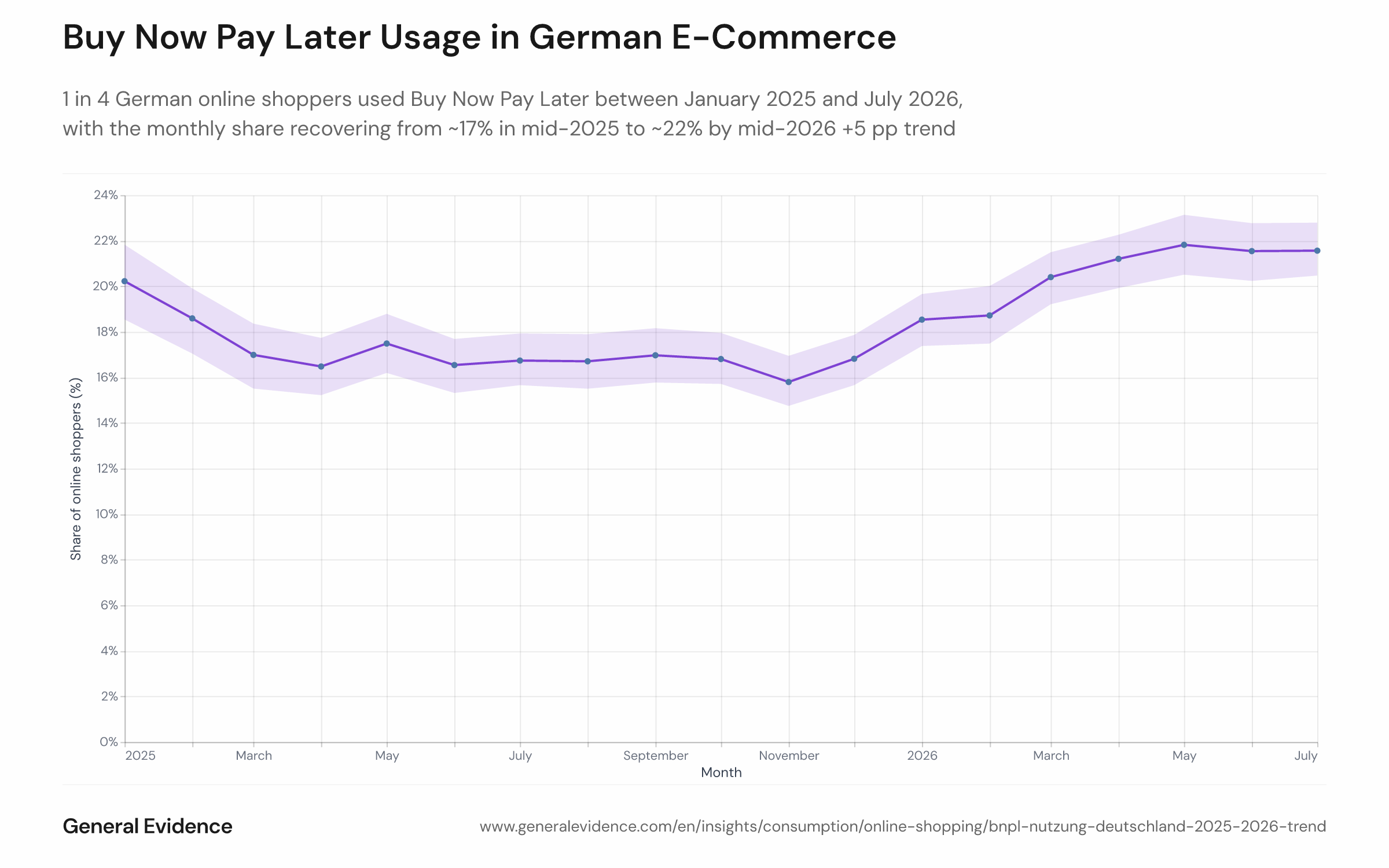
Info
- Sample size
- n = 16,671
- Data date
- Jan 2025 – Jul 2026
- Segment
- All segments
- Platform
- Email, Purchases
- Market
- Germany
Analysis
25% of active German online shoppers carried a Buy Now Pay Later signal at some point during January 2025–July 2026, but the monthly picture tells a more nuanced story: usage dipped to roughly 17% in mid-2025 before climbing back to around 22% through the first half of 2026 — with no Black Friday spike in November 2025, which was actually the period's low point.
Why November 2025 disappointed BNPL providers
Germany's BNPL market has long been shaped by deep-rooted invoice-payment culture — consumers historically prefer to receive goods before settling the bill. The 2025 holiday season appears not to have driven the installment-payment surge retailers might have hoped for, possibly because Germany's sluggish consumer sentiment kept discretionary spending cautious. Meanwhile, the regulatory backdrop is shifting fast: the Bundestag passed the CCD II implementation law in April 2026, with the full regulatory framework for Ratenkauf and BNPL set to apply from 20 November 2026. The prospect of mandatory credit checks at checkout may be shaping provider and merchant behavior already, while the steady climb through H1 2026 suggests that flexible deferred-payment options are becoming more embedded in German online shopping — even ahead of the new rules.
See also the provider breakdown to understand who is capturing that demand.
This analysis is based on public segment data. For deeper cuts, use our Enterprise interface.
Methodology
The share shown is the proportion of German online shoppers with at least one physical-goods purchase per month who also showed a Buy Now Pay Later payment signal in that same month. BNPL signals include explicit installment-payment labels from Klarna, Ratepay, and Riverty, as well as Klarna and Riverty servicing emails and PayPal installment notifications. Results are weighted to reflect the German adult online-shopping population. The analysis covers January 2025 through July 2026, with monthly data points across all 19 months.
These insights are based on the General Evidence Panel. Our data comes exclusively from users who are compensated for their anonymity. Become part of the panel & earn from your data