Prime Big Deal Days 2025: Order Lift in Germany
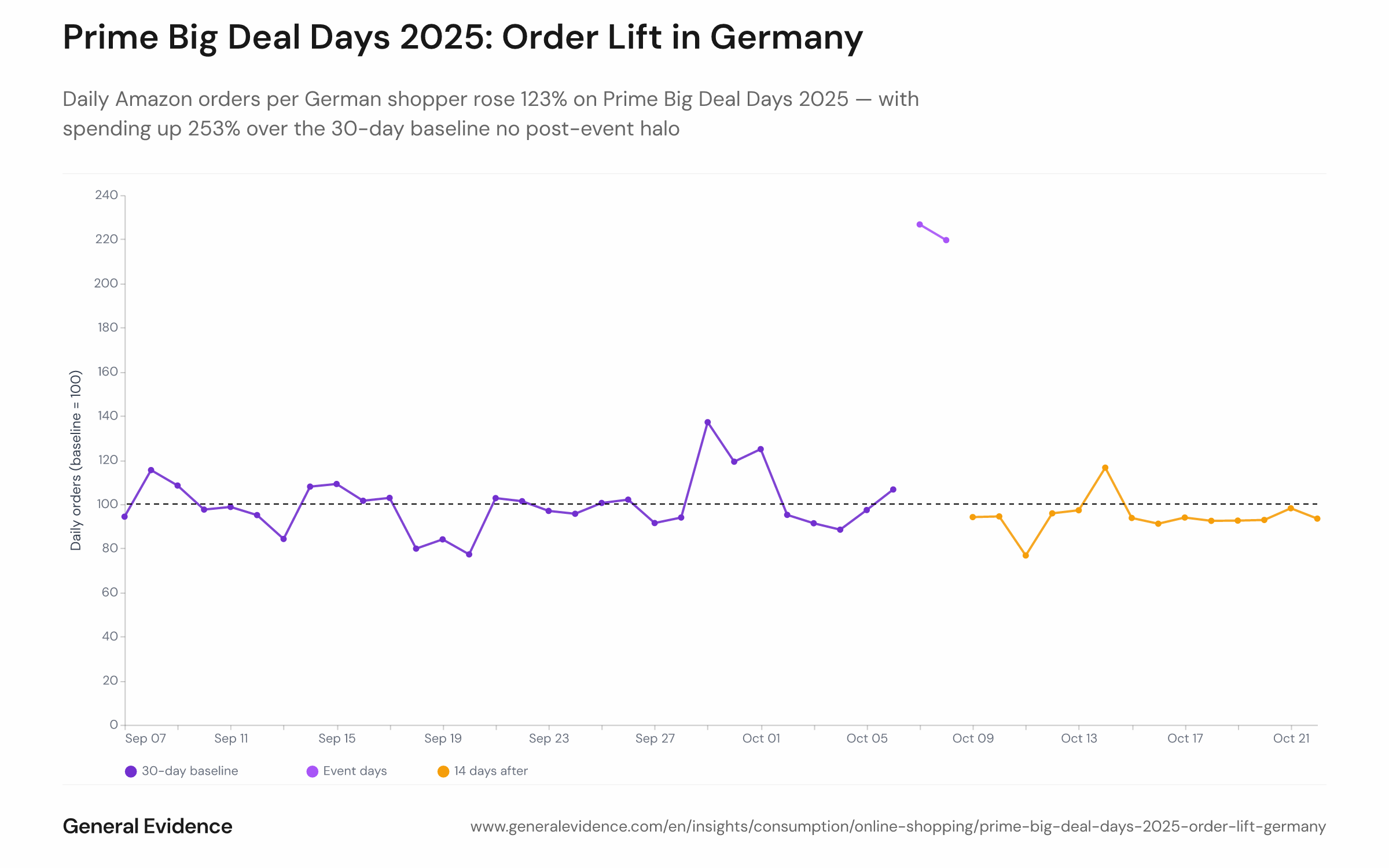
Review Oct 7–8, 2025: Daily Amazon orders per German shopper rose 123% on Prime Big Deal Days 2025 — with spending up 253% over the 30-day baseline no post-event halo
Info
- Sample size
- n = 5,900
- Data date
- Oct 7–8, 2025
- Segment
- All segments
- Platform
- Purchases
- Market
- Germany
Analysis
Amazon's Prime Big Deal Days on October 7–8, 2025 drove a 123% surge in daily orders per German shopper versus the preceding 30-day baseline — and spending climbed an even sharper 253%, meaning shoppers who bought, bought bigger. The event outperformed every other Amazon sale measured in Germany in 2025 and early 2026: it beat Black Friday 2025 (+101%), Prime Day July 2025 (+90%) and Prime Day June 2026 (+77%) on a per-day basis.
Weihnachtsstart statt Zusatzkauf
The October event has served as an unofficial holiday-shopping kickoff since Amazon launched it in 2022 — and German order patterns reflect exactly that dynamic. Category data shows Baby & Toddler orders hitting 4.7× baseline and Toys & Games reaching 3.7×, consistent with early Christmas gifting (see category lift by Prime Deal Days). Crucially, the 14 days after the event ran 5.5% below baseline, indicating that October demand was pulled forward from the post-event calendar rather than created net-new. Amazon's fall Prime event has become a bellwether for fourth-quarter demand while also pulling forward spending before Black Friday. With the 2026 edition confirmed for October 6–7, the 2025 data is the freshest completed benchmark available for planning the upcoming event.
This analysis is based on public segment data. For deeper cuts, use our Enterprise interface.
Ask your own question of this data.
This chart is one cut of the panel. In a demo we answer your question on the same data, live.
Methodology
Daily Amazon order and spending activity was tracked for German online shoppers over a 46-day window from September 7 to October 22, 2025, covering 30 baseline days before the Prime Big Deal Days event (October 7–8) and 14 days after. A fixed cohort of shoppers with continuous Amazon purchase-history coverage across the full window was used, calibrated to German adults aged 18 and over. Order lift is calculated as the mean daily orders per shopper during event days divided by the mean during baseline days, minus one. Spending lift applies the same method to daily spend, with per-shopper daily spend capped at a high-end threshold to limit the influence of outlier transactions. The post-event dip metric compares mean daily orders in the 14 days following the event against the 30-day pre-event baseline. The October 6–7, 2026 edition had not concluded at the time of analysis; 2025 figures represent the most recent fully observed instance.
These insights are based on the General Evidence Panel. Our data comes exclusively from users who are compensated for their anonymity. Become part of the panel & earn from your data