Digital Subscription Stacking by Generation in Germany
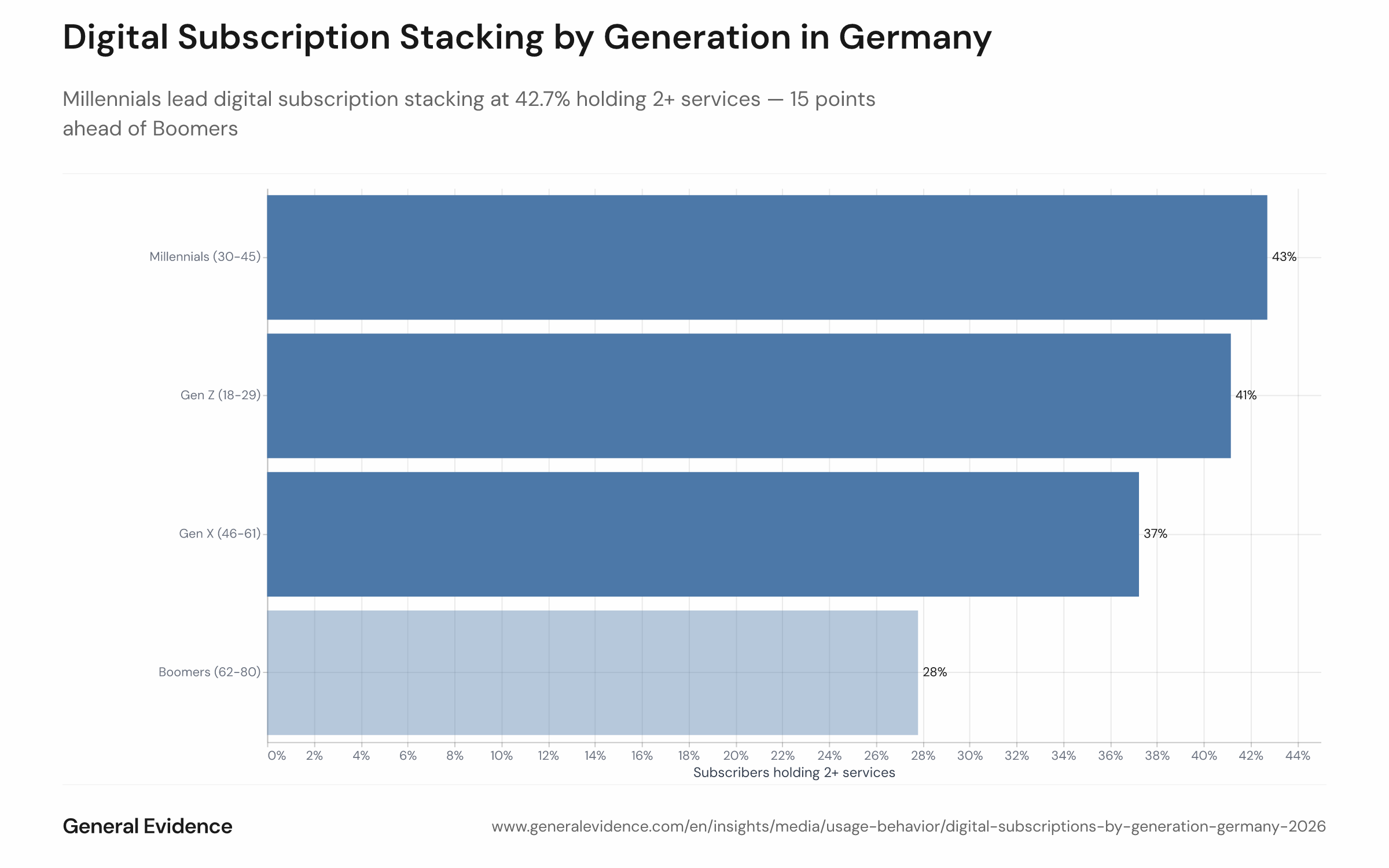
Review Q3 2026: Millennials lead digital subscription stacking at 42.7% holding 2+ services — 15 points ahead of Boomers
License: CC BY 4.0 · Source: General Evidence · How to reuse
Info
- Sample size
- n = 14,877
- Data date
- Q3 2026
- Segment
- 16-24, 25-34, 35-44, 45-54, 55+
- Platform
- Email, Emails
- Market
- Germany
Analysis
Among Germans who pay for at least one digital subscription, Millennials (ages 30–45) are the most likely to stack services: 42.7% hold two or more. Gen Z (18–29) follows closely at 41.2%, while Gen X (46–61) trails at 37.2%. The gap between the youngest and oldest working-age generation is statistically meaningful and points to where multi-service habits are forming.
Why younger cohorts stack more
The Postbank Digital Study 2026 found that paid streaming services reach 90% of Germans aged 18 to 39, compared to 63% among adults over 40 — making younger consumers both more likely to subscribe at all and more likely to hold multiple services simultaneously. Millennials and Gen Z are the primary audiences for gaming passes, music streaming, and cloud storage, the categories most commonly stacked alongside a video service. For a full picture of how concentrated Germany's subscriber base really is — across all generations — see the overall subscription count distribution. The data suggests that subscription growth in Germany will be driven less by new adopters and more by converting single-service Millennials and Gen Z subscribers into multi-service customers.
This analysis is based on public segment data. For deeper cuts, use our Enterprise interface.
Ask your own question of this data.
This chart is one cut of the panel. Tell us what you want to know: we run it on the same data and email you first results within one business day.
Rather talk it through? Book a demo
Methodology
Figures cover German adults with at least one paid digital subscription active during July–September 2026, broken out by generation: Gen Z (born 1997–2008, ages 18–29 in 2026), Millennials (born 1981–1996, ages 30–45), and Gen X (born 1965–1980, ages 46–61). The share shown is the proportion of subscribers within each generation who hold two or more distinct services, weighted to match the German online adult population by age, gender, region, education, and income. Covered categories include streaming video, music and audio, gaming, news, cloud storage, and fitness apps; shopping memberships, AI tools, and physical services are excluded. Only billing receipts arriving in a connected email inbox are captured, so counts represent a lower bound on true subscription stacks.
These insights are based on the General Evidence Panel. Our data comes exclusively from users who are compensated for sharing their data. Become part of the panel & earn from your data