When Germans Open Podcast & Audiobook Apps
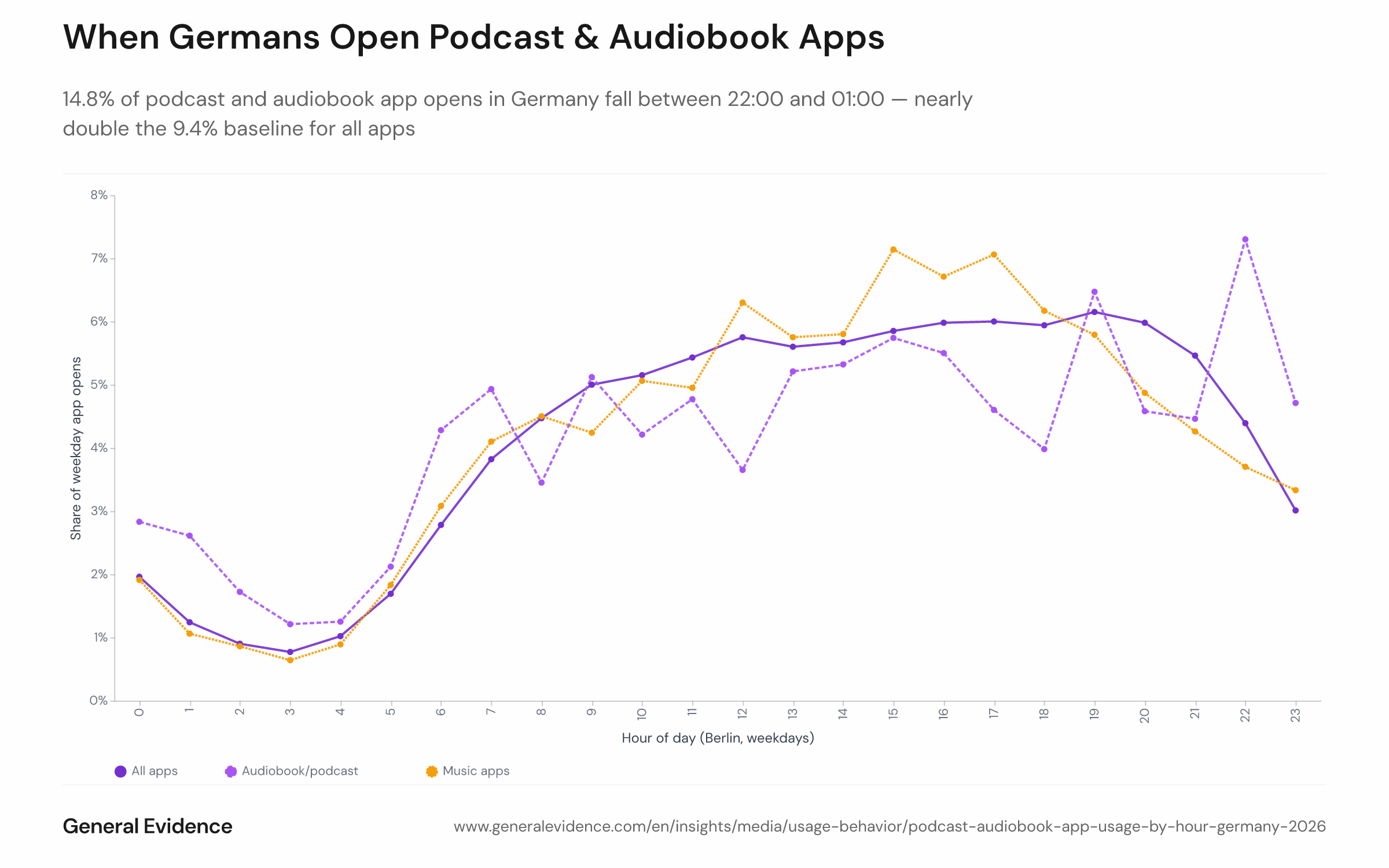
Review Sep–Oct 2026: 14.8% of podcast and audiobook app opens in Germany fall between 22:00 and 01:00 — nearly double the 9.4% baseline for all apps
License: CC BY 4.0 · Source: General Evidence · How to reuse
Info
- Sample size
- n = 644
- Data date
- Sep–Oct 2026
- Segment
- All segments
- Platform
- Android
- Market
- Germany
Analysis
The commuter narrative around podcast listening in Germany does not hold up in app-open data. On weekdays, only 16.9% of audiobook and podcast app opens fall within classic commute windows (07–09 and 17–19), below the 20.2% baseline for all apps and the 21.8% share recorded for music apps. Instead, the late-night window from 22:00 to 01:00 accounts for 14.8% of opens — nearly twice the all-app rate of 9.4%. The pattern points to winding-down listening rather than commuter listening as the defining use case for dedicated audio apps like Audible and ARD Audiothek.
Einschlafen schlägt Pendeln
Survey-based studies in Germany, including the RMS Podcast-Studie 2026, confirm the home as the dominant listening environment: 91% of podcast listeners tune in at home, and around 30% do so specifically while falling asleep or waking up. The agma ma Podcast data for early 2026 similarly shows that afternoon and evening hours (14:00–22:00) together account for the largest share of podcast consumption — a pattern that app-open timing reinforces. This does not mean commute listening is absent; 29% of German podcast listeners report listening on the way to work or school. But on Android, those commute opens are not disproportionate for dedicated audio apps — music apps, not podcast apps, spike hardest in morning rush hours. For context on how short those commute-hour app interactions actually are, see audio app screen time on Android.
This analysis is based on public segment data. For deeper cuts, use our Enterprise interface.
Ask your own question of this data.
This chart is one cut of the panel. In a demo we answer your question on the same data, live.
Methodology
App session start times were recorded on Android devices in Germany on weekdays between 1 September and 28 October 2026, using Berlin local time. For each user, session starts were converted into an hourly share of that person's daily opens, so that heavier users do not dominate the aggregate. These individual shares were then averaged using weights calibrated to German adults aged 18 and over. The audiobook and podcast group includes Audible, Pocket FM, ARD Sounds, Podimo, BookBeat, Storytel, Nextory, Pocket Casts, Deutschlandfunk, Castbox, and Blinkist. The music group covers Spotify, YouTube Music, Amazon Music, Deezer, Apple Music, SoundCloud, and TIDAL. Because podcast listening inside Spotify cannot be separated from music listening, Spotify is counted in the music group throughout. Session starts measure when the app is opened, not how long audio plays afterwards.
These insights are based on the General Evidence Panel. Our data comes exclusively from users who are compensated for sharing their data. Become part of the panel & earn from your data