TikTok & YouTube Peak Viewing Hours in Germany
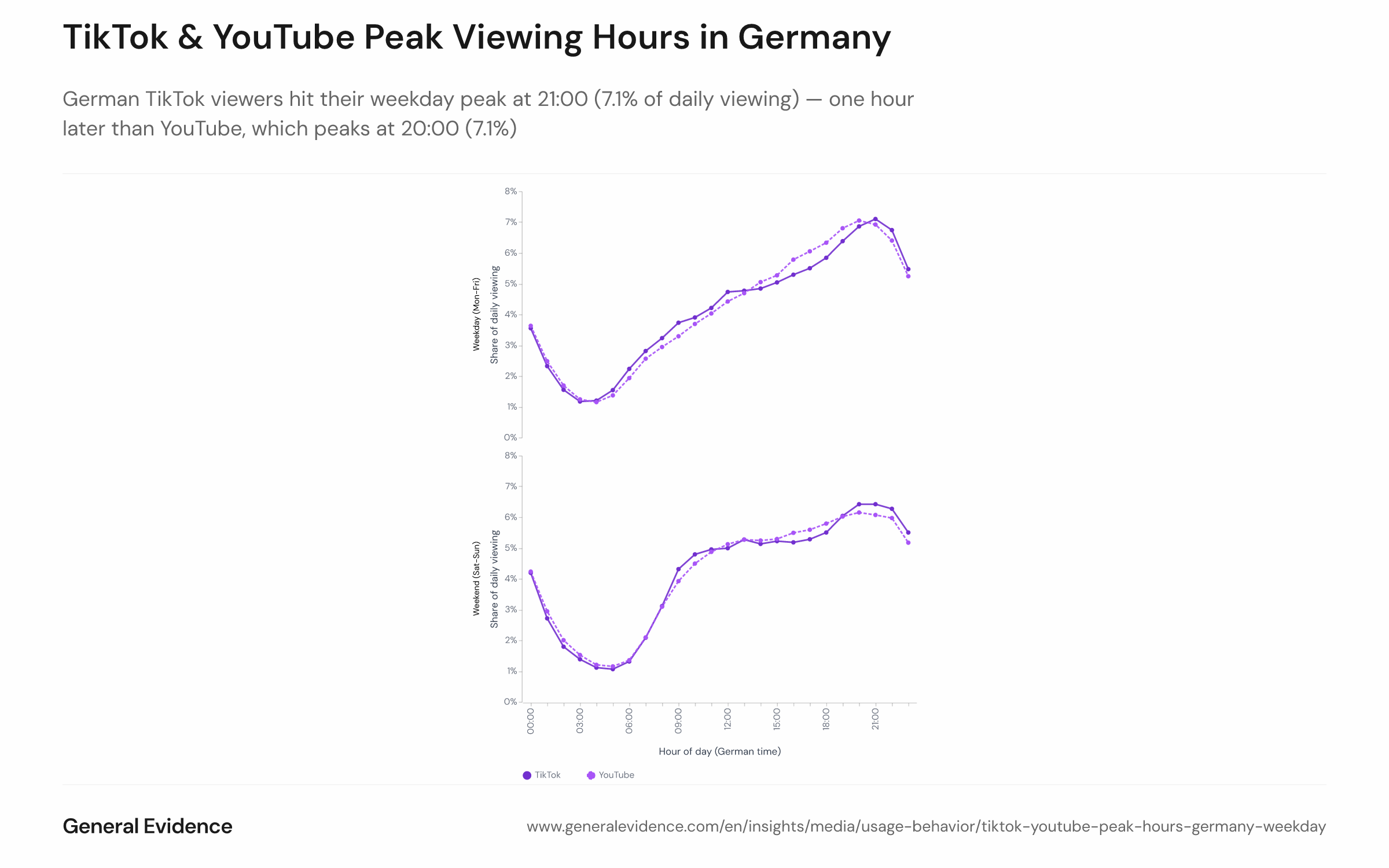
Review Jan–Sep 2026: German TikTok viewers hit their weekday peak at 21:00 (7.1% of daily viewing) — one hour later than YouTube, which peaks at 20:00 (7.1%)
Info
- Sample size
- n = 37,922
- Data date
- Jan–Sep 2026
- Segment
- 16-24, 25-34, 35-44, 45-54, 55+
- Platform
- TikTok, YouTube
- Market
- Germany
Analysis
On German weekdays, TikTok and YouTube share the same peak intensity — 7.1% of a viewer's daily activity in a single hour — but TikTok's primetime falls reliably one hour later than YouTube's. That one-hour gap is not a statistical artifact: the 21:00 peak for TikTok held in every one of 300 bootstrap resamples, making it one of the most stable platform-timing differences measured in Germany in 2026.
Why TikTok's primetime skews later
The shift aligns with broader German media habits: linear TV viewership in Germany traditionally peaks around 21:00, and video-on-demand behaviour has followed suit rather than replacing that rhythm. TikTok's short-form, algorithmically curated feed encourages later, longer wind-down sessions compared to YouTube's longer videos, which tend to attract earlier, more deliberate viewing. YouTube also draws significantly more afternoon viewing than TikTok — between 15:00 and 19:59, YouTube accounts for 30.2% of its daily viewing versus TikTok's 28.1% — suggesting YouTube is woven into the post-work routine earlier in the evening. For marketers planning Germany campaigns, this one-hour gap means the optimal Social Media Primetime on TikTok starts meaningfully after the YouTube sweet spot: audience attention on both platforms converges only briefly, at 20:00. One counterintuitive finding: the expected late-night (22:00–02:00) skew for under-30s is actually stronger on YouTube (20.7%) than on TikTok (18.8%), a reminder that platform stereotypes about young audiences scrolling TikTok into the early hours do not hold in actual German viewing data for 2026.
This analysis is based on public segment data. For deeper cuts, use our Enterprise interface.
Ask your own question of this data.
This chart is one cut of the panel. In a demo we answer your question on the same data, live.
Methodology
Viewing activity among German adults aged 18 to 80 was tracked from January to September 2026. For each platform, only viewers with at least seven active viewing days and twenty or more watch events on weekdays were included — ensuring the hourly profile reflects genuine regular users, not one-off sessions. Each viewer's daily activity was converted to a share of their own total viewing, so heavy users do not dominate the result. Shares were then averaged across viewers and weighted to represent the German adult online population by age, gender, region, and income. Hourly peaks and confidence ranges were validated with 300 bootstrap resamples. The TikTok base comprised roughly 11,600 regular weekday viewers; the YouTube base roughly 26,300. YouTube activity spans all surfaces — app, browser, and connected TV — without a device split. Because TikTok watch events reflect short clips while YouTube events can cover longer videos, only the within-platform hourly shape is compared across platforms, not absolute viewing volumes.
These insights are based on the General Evidence Panel. Our data comes exclusively from users who are compensated for sharing their data. Become part of the panel & earn from your data