How Long Germans Research Before Buying Online
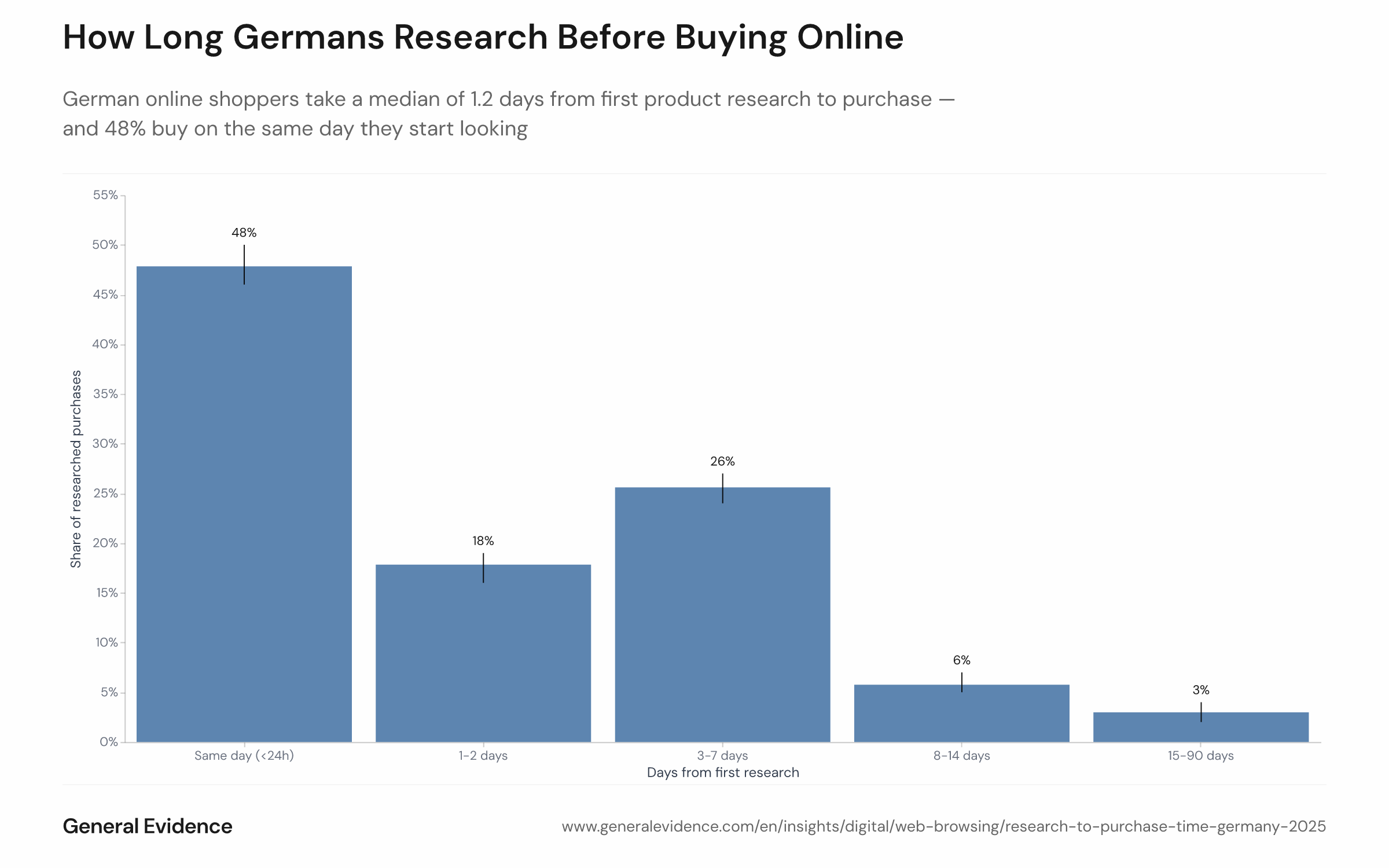
Review 2025: German online shoppers take a median of 1.2 days from first product research to purchase — and 48% buy on the same day they start looking
Info
- Sample size
- n = 19,016
- Data date
- 2025
- Segment
- All segments
- Platform
- Browsing, Purchases, Search
- Market
- Germany
Analysis
The German online purchase funnel is far shorter than the "thorough German researcher" stereotype suggests: the median gap between a shopper's first in-category touchpoint and checkout is just 1.15 days, with nearly half of all purchases completing within 24 hours of the first research signal. A further 18% convert within one to two days, meaning roughly two-thirds of the customer journey collapses inside 72 hours.
The myth of the methodical German shopper
Germany has a reputation for deliberate, research-heavy buying behavior — surveys consistently show that over 60% of German consumers compare prices and read reviews before purchasing. Yet when actual browsing and search trails are matched to real transactions in 2025, active product research compresses into a narrow window. The critical distinction is between passive category interest (which can span weeks) and an active research chain — a sequence of product-page visits and search queries with no gap longer than seven days leading up to a purchase. Within that active funnel, urgency dominates: only 8.7% of purchases followed a research phase lasting more than a week. Marketers targeting German shoppers should note that retargeting windows of 24–72 hours capture the lion's share of conversions; longer attribution windows likely blend background browsing with genuine purchase intent. Category plays a larger role in stretching the research window than price does — see Research time by product category for the full breakdown.
This analysis is based on public segment data. For deeper cuts, use our Enterprise interface.
Ask your own question of this data.
This chart is one cut of the panel. In a demo we answer your question on the same data, live.
Methodology
The analysis covers German online shoppers throughout 2025. Purchases were drawn from online product sources including Amazon orders, email order confirmations, and TikTok Shop transactions, restricted to identifiable Shopify product taxonomy categories. Research touchpoints were defined as product-page visits and Google search queries tagged with a product category, matched to the same category as the subsequent purchase. The research-to-purchase funnel was built by walking back from each purchase through a connected chain of touchpoints with no single gap exceeding seven days, bounded by the prior 90 days and the shopper's most recent purchase in that category. Only shoppers whose full browsing and search history was observable across the entire lookback window were included; roughly 16% of all qualifying purchase occasions had a detectable research chain and form the basis of this measurement. Each shopper's purchases were weighted equally to prevent heavy buyers from distorting the result. Time-to-purchase distributions and share estimates are based on this active-funnel subset.
These insights are based on the General Evidence Panel. Our data comes exclusively from users who are compensated for their anonymity. Become part of the panel & earn from your data