Browse-to-Buy Conversion by Category
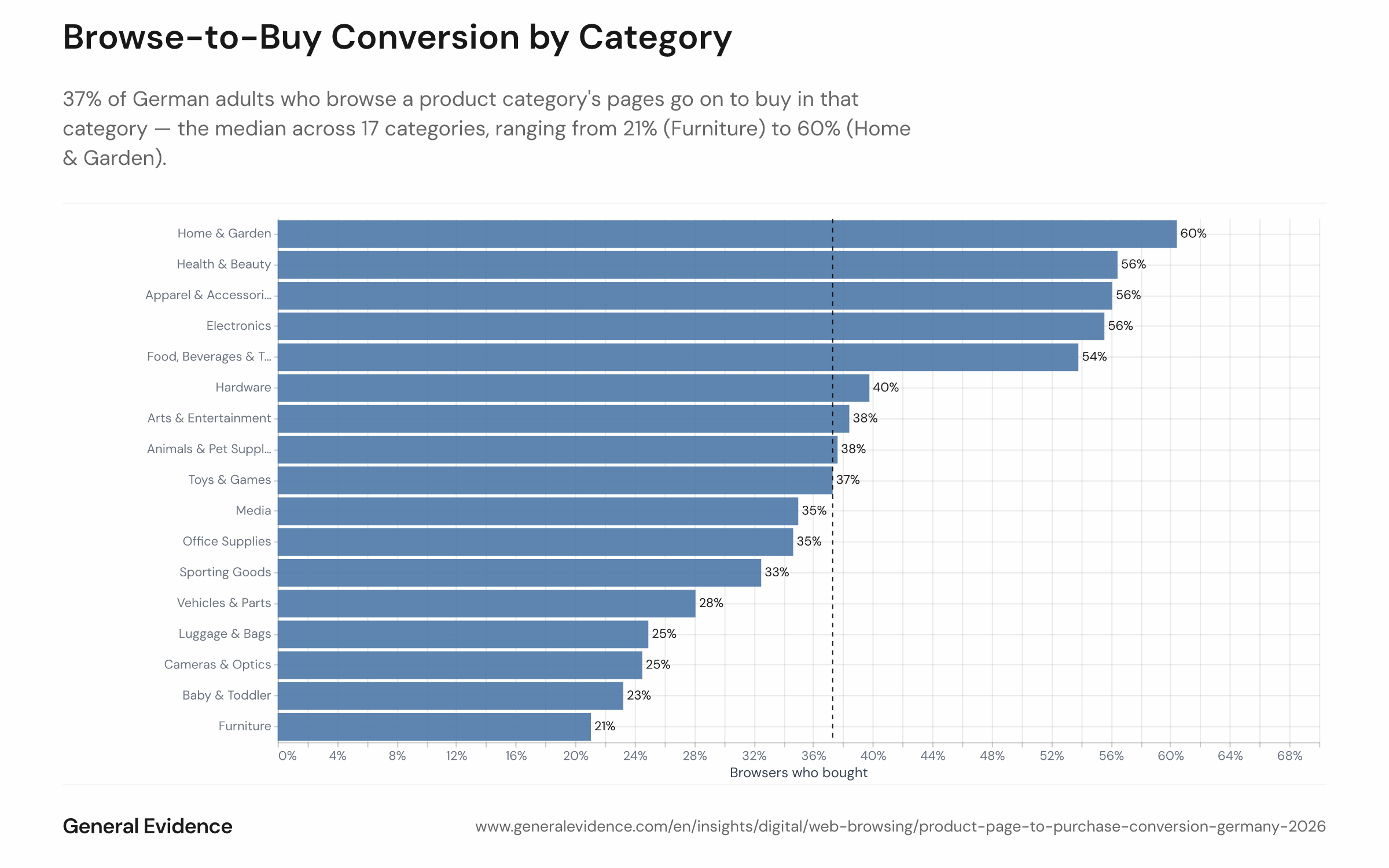
Review April–September 2026: 37% of German adults who browse a product category's pages go on to buy in that category — the median across 17 categories, ranging from 21% (Furniture) to 60% (Home & Garden).
Info
- Sample size
- n = 9,770
- Data date
- April–September 2026
- Segment
- All segments
- Platform
- Browsing, Purchases
- Market
- Germany
Analysis
Across 17 consumer categories, a median 37% of German adults who viewed product pages in a category between April and September 2026 also made a purchase in that category within the same six-month window — meaning roughly 63% browsed without buying. The 39-percentage-point spread between the worst-converting category (Furniture at 21%) and the best (Home & Garden at 60%) shows that "browse-to-buy" is not a single number: category structure matters far more than any aggregate benchmark.
Why repeat-purchase categories convert twice as well
Five categories — Home & Garden, Health & Beauty, Apparel & Accessories, Electronics, and Food, Beverages & Tobacco — all landed between 54% and 60%, well above the median. What they share is a high repurchase frequency: German consumers who browse these categories have typically bought there before and are often looking to reorder or replenish rather than deliberate for the first time. Industry data on German online shopping confirms that grocery and personal-care categories see the lowest cart abandonment rates globally, precisely because repeat buyers arrive with clear intent. In contrast, big-ticket or infrequent-purchase categories — Furniture (21%), Baby & Toddler (23%), Cameras & Optics (25%), Luggage & Bags (25%) — sit at the bottom, consistent with the longer consideration cycles documented for high-value items in European e-commerce. Cart abandonment research for Germany in 2026 puts the overall cart-level non-conversion rate at roughly 69–70%, a figure that is structurally higher than the product-page non-conversion rate measured here, because many browsers never add an item to their cart at all. Device type proved surprisingly neutral: phone-only and desktop-only browsers both converted at 37–38%, suggesting that the friction German shoppers experience is category-driven, not interface-driven.
This analysis is based on public segment data. For deeper cuts, use our Enterprise interface.
Ask your own question of this data.
This chart is one cut of the panel. In a demo we answer your question on the same data, live.
Methodology
The conversion rate shown is the share of German adults (18+) who visited at least one product page in a given category between April and September 2026 and also made an online purchase in that same category during the same six-month period. Purchases are tracked across major online channels including marketplace orders, email receipts, and checkout events for physical goods. To ensure both browsing and purchase behaviour are observable for the same person, only panellists with confirmed coverage of both browsing activity and purchase records are included. Estimates are weighted to represent German adults and cover 17 top-level consumer product categories.
These insights are based on the General Evidence Panel. Our data comes exclusively from users who are compensated for their anonymity. Become part of the panel & earn from your data