Fastest-Growing Online Category in Germany
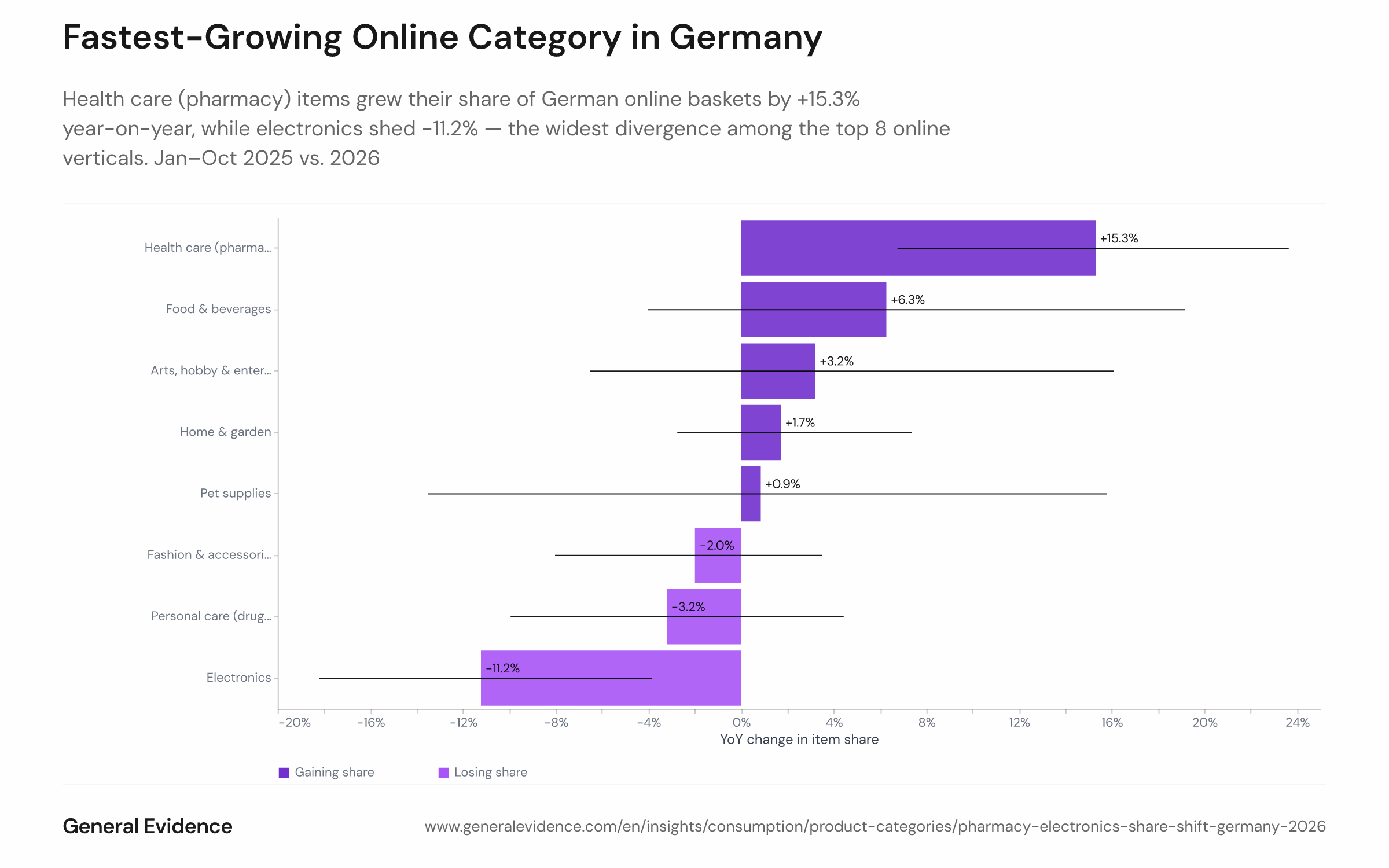
Review Jan–Oct 2025 vs. Jan–Oct 2026: Health care (pharmacy) items grew their share of German online baskets by +15.3% year-on-year, while electronics shed −11.2% — the widest divergence among the top 8 online verticals. Jan–Oct 2025 vs. 2026
License: CC BY 4.0 · Source: General Evidence · How to reuse
Info
- Sample size
- n = 7,539
- Data date
- Jan–Oct 2025 vs. Jan–Oct 2026
- Segment
- All segments
- Platform
- Purchases
- Market
- Germany
Analysis
Pharmacy is now the single fastest-growing online vertical in Germany — its share of purchased items rose +15.3% year-on-year (confidence range: +6.8% to +23.6%), a gain that is both statistically clear and commercially significant. Among the top 8 online verticals by purchase volume, no other category comes close: food & beverages grew a modest +6.3%, home & garden +1.7%, while fashion was essentially flat at −2.0%.
The e-prescription and medical cannabis effect
The pharmacy surge is structural, not seasonal. Germany's e-prescription rollout — which became mandatory for all statutory insurers in 2024 — made online pharmacies into routine infrastructure rather than a convenience option. Online pharmacy revenue grew nearly 10% in Q1 2026 alone, the strongest increase since e-prescriptions were introduced, according to bevh data. Within pharmacy, medical cannabis is driving an outsized share of new buyers: the share of online health-care shoppers who purchased medical cannabis rose from 4.7% to 7.3% between Jan–Oct 2025 and Jan–Oct 2026 — see Medical cannabis buyers in Germany for the full breakdown. Germany's medical cannabis market, valued at roughly €1 billion in 2025, more than doubled in a year as the April 2024 Cannabis Act removed cannabis from narcotics classification and opened telemedicine-based prescribing at scale.
Electronics' decline — the steepest in the ranking at −11.2% — mirrors industry data: the German electronics market contracted 2.5% in revenue in H1 2026, with consumer electronics down 3.2%. Spending is shifting from big-ticket, infrequent purchases toward replenishment categories like health, food, and drugstore. Drugstore items (personal care) were flat at −3.2%, consistent with bevh reporting drugstore growth in revenue terms — a discrepancy explained by falling unit prices rather than falling demand.
This analysis is based on public segment data. For deeper cuts, use our Enterprise interface.
Ask your own question of this data.
This chart is one cut of the panel. In a demo we answer your question on the same data, live.
Methodology
The analysis tracks a fixed group of German online shoppers who made at least one physical-goods purchase in both Jan–Oct 2025 and Jan–Oct 2026. Purchase records come from email order confirmations, Amazon order exports, and browsing-inferred checkouts; in-store receipts, digital goods, and restaurant orders are excluded. Each purchase is assigned to one of the top 8 online verticals by 2025 purchase volume, using a standardised retail taxonomy (health care covers pharmacy and OTC products; personal care covers drugstore). The metric is each vertical's share of total purchased line items in each window — not raw counts — because share change isolates relative growth independently of overall order-volume shifts. Year-on-year change is the 2026 share divided by the 2025 share, minus one. Estimates are weighted to reflect the German online-shopping population by age, gender, region, education, and income. The confidence range is derived from 300-draw user-level resampling.
These insights are based on the General Evidence Panel. Our data comes exclusively from users who are compensated for sharing their data. Become part of the panel & earn from your data