Eclipse Search Intensity: 2026 vs. 2025
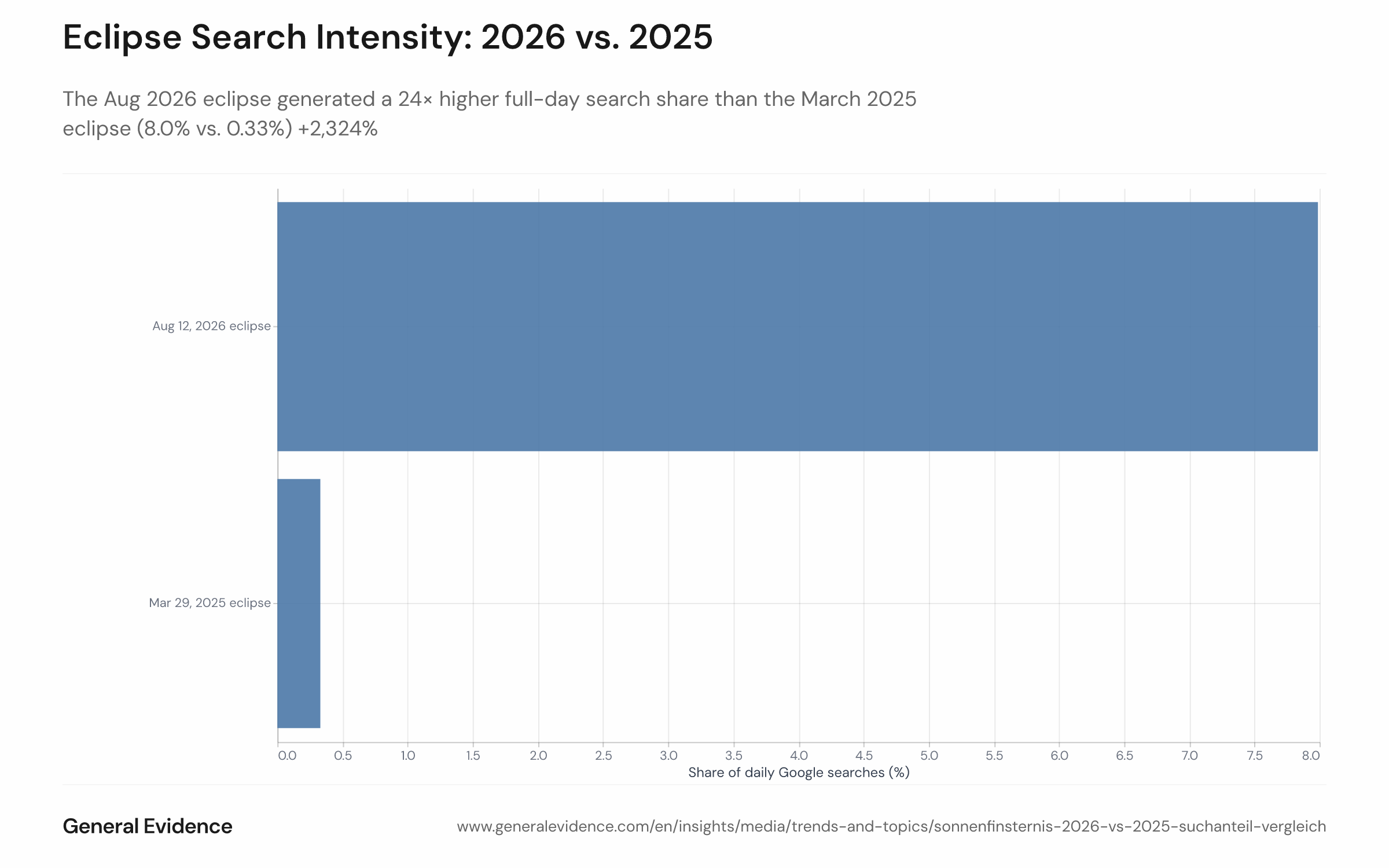
Review Mar 29, 2025 vs. Aug 12, 2026: The Aug 2026 eclipse generated a 24× higher full-day search share than the March 2025 eclipse (8.0% vs. 0.33%) +2,324%
Info
- Sample size
- n = 29,434
- Data date
- Mar 29, 2025 vs. Aug 12, 2026
- Segment
- All segments
- Platform
- Search
- Market
- Germany
Analysis
On August 12, 2026, solar-eclipse terms accounted for 8.0% of all daily Google searches in Germany — 24 times the 0.33% share recorded on March 29, 2025. The gap in peak-hour intensity was even wider: 31.4% versus 1.5%, roughly a 20× difference. Both were partial eclipses visible from Germany, yet the events were categorically different in scale.
Coverage depth and timing explain the gap
The March 2025 eclipse covered only around 15% of the sun over Berlin and occurred at midday on a Saturday — a day with lower baseline search traffic and a less dramatic visual event. The August 2026 eclipse, by contrast, blotted out up to 90% of the sun over southern Germany and fell during a weekday evening, coinciding with the Perseid meteor shower peak and extensive cross-platform media coverage. Broadcasters including ZDF and 3sat ran dedicated evening programs, and the ESA streamed live from Spain, all amplifying search intent. The data suggest that solar-coverage depth — not just astronomical category — is the primary driver of public search interest.
This analysis is based on public segment data. For deeper cuts, use our Enterprise interface.
Methodology
Full-day share of Google search queries containing solar-eclipse terms among German adult online users, comparing August 12, 2026 (eclipse day) with March 29, 2025 (the previous comparable eclipse day). Shares are computed as eclipse-term searches divided by total searches on the same calendar day, making both figures directly comparable despite different total search volumes. Peak-hour figures reflect the single highest-share hour on each respective day.
These insights are based on the General Evidence Panel. Our data comes exclusively from users who are compensated for their anonymity. Become part of the panel & earn from your data