ChatGPT Shopping Categories in Germany 2026
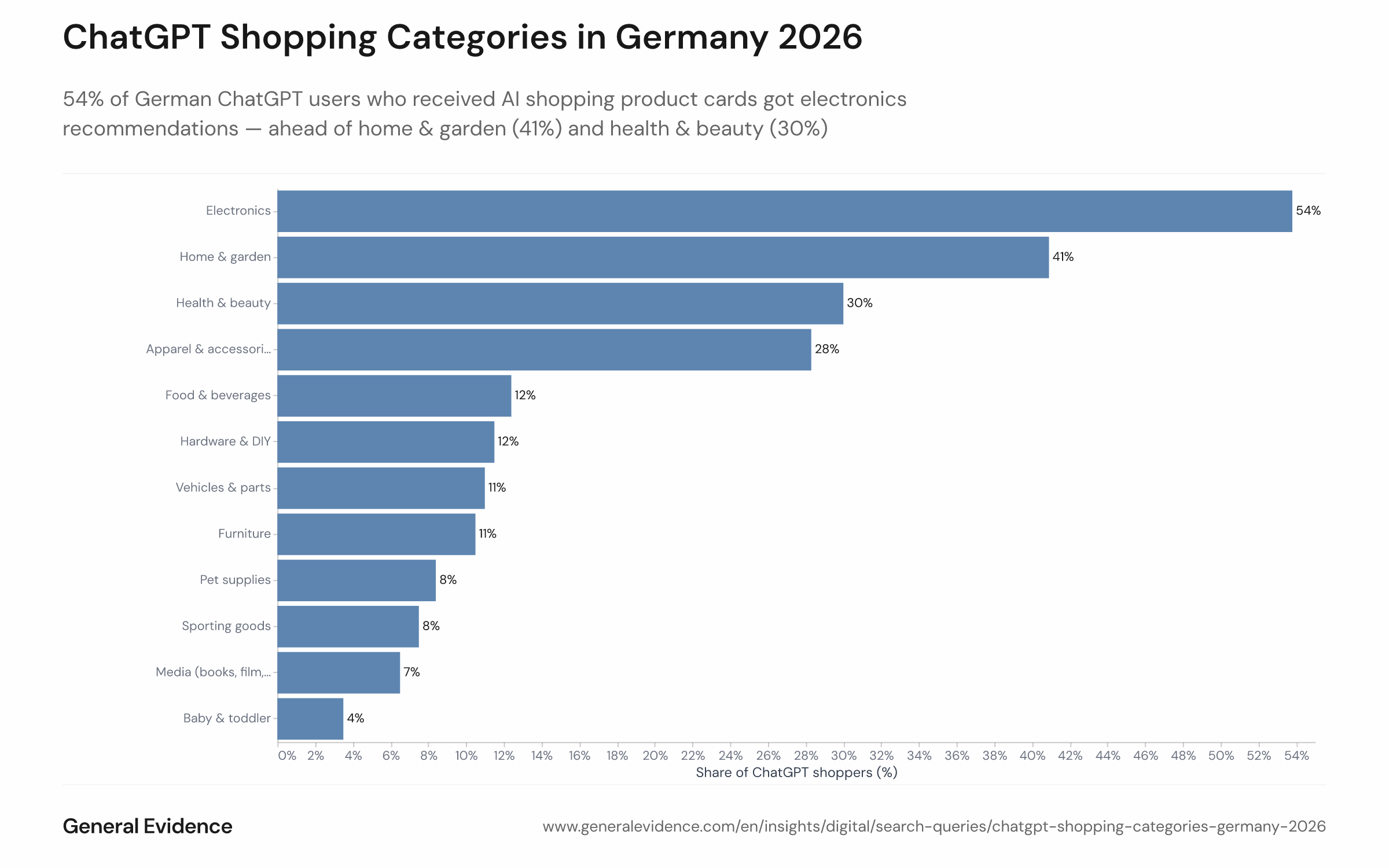
Review Jan–Nov 2026: 54% of German ChatGPT users who received AI shopping product cards got electronics recommendations — ahead of home & garden (41%) and health & beauty (30%)
License: CC BY 4.0 · Source: General Evidence · How to reuse
Info
- Sample size
- n = 429
- Data date
- Jan–Nov 2026
- Segment
- All segments
- Platform
- Chatgpt
- Market
- Germany
Analysis
Electronics dominates ChatGPT's AI shopping product cards for German users in 2026, reaching 54% of shoppers — a category lead that likely reflects both the high complexity of consumer electronics decisions and the depth of product data available to the model. Home & garden follows at 41%, health & beauty at 30%, and apparel & accessories at 28%, while food & beverages trails at just 12%.
Why electronics leads AI product search
ChatGPT's shopping feature launched in Germany in April 2025 and was significantly expanded through 2026, with OpenAI pivoting in March 2026 from an in-chat checkout model toward a richer product discovery experience. Electronics is a natural fit: comparisons across specs, price tiers, and brands are exactly the kind of multi-criteria research where conversational AI adds the most value over a traditional keyword search. The category's dominance in ChatGPT product cards mirrors its structural weight in German e-commerce — Germany's online retail sector generated over €83 billion in 2025, with consumer electronics consistently among the top-spending categories. Health & beauty and apparel, the third and fourth categories here, are equally prominent in German online retail and represent high-frequency, high-consideration purchase decisions. Food & beverages, by contrast, remains largely a low-consideration, habitual purchase — which may explain why it converts to AI-assisted product cards far less often. For a view of which retailers are shown most on those product cards, see Amazon's lead merchant share in ChatGPT.
This analysis is based on public segment data. For deeper cuts, use our Enterprise interface.
Ask your own question of this data.
This chart is one cut of the panel. Tell us what you want to know: we run it on the same data and email you first results within one business day.
Rather talk it through? Book a demo
Methodology
The analysis covers German ChatGPT users who imported their conversation history and had at least one shopping product card in their conversations between January 1 and November 6, 2026. A conversation was classified as a shopping conversation if it contained at least one ChatGPT product card. Each card was assigned to a category based on keyword matching against product and conversation titles, using a Shopify-style vertical taxonomy in both German and English. Where a conversation contained cards from multiple categories, it was assigned to the majority category. Conversations where no majority category could be established (14% of shopping conversations) were excluded from the category breakdown. Shares represent the proportion of shoppers who received at least one card in each category; a shopper can appear in more than one bar. Figures are weighted to reflect the broader population of German ChatGPT users active in 2026.
These insights are based on the General Evidence Panel. Our data comes exclusively from users who are compensated for sharing their data. Become part of the panel & earn from your data